IMPULS3

A Systems Engineering method

IMPULS3 is a structured method for Systems Engineering, with an emphasis on Requirements Engineering, that ensures stakeholder needs are translated into clear, complete, and verifiable system requirements. It is based on the principle that any system can be fully defined by its functions, properties, and constraints, enabling a consistent and unambiguous specification. By emphasizing traceability, from stakeholder needs to requirements and further into design, IMPULS3 helps organizations maintain control over complexity, preserve the original intent of requirements, and support reliable decision-making throughout the entire system lifecycle.
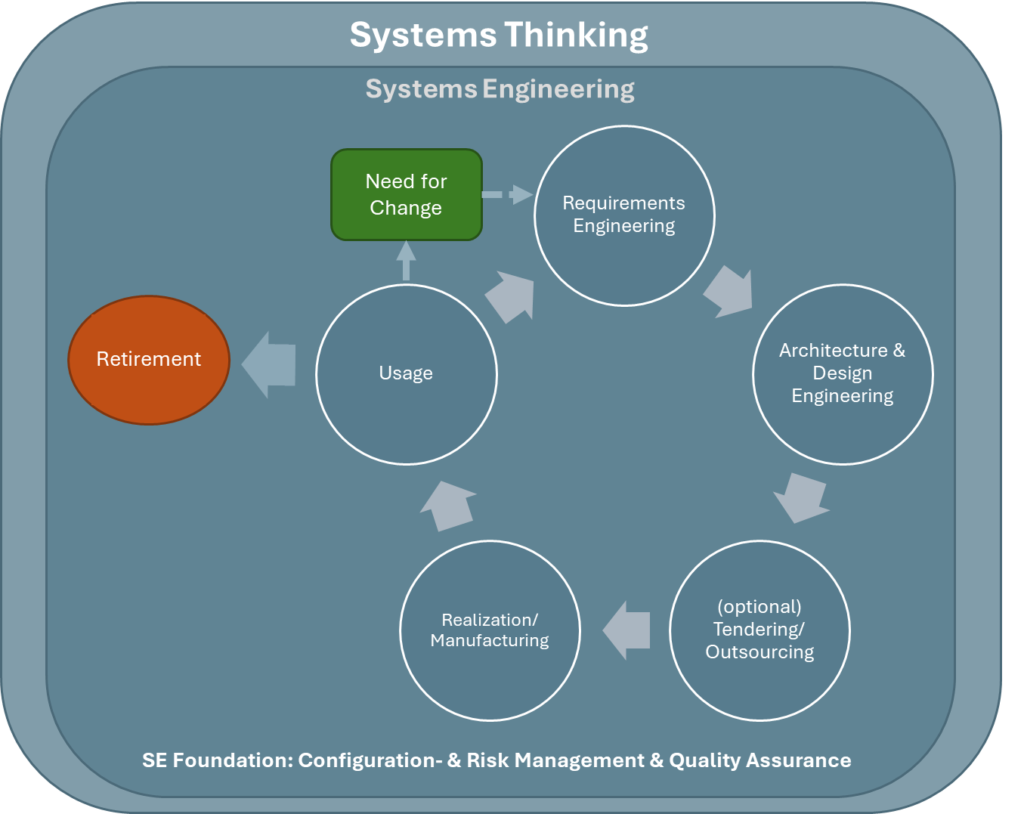
This diagram shows how IMPULS3 integrates Requirements Engineering within the full system lifecycle, from initial need for change to system usage and retirement, while maintaining traceability and control at every step.


What makes IMPULS3 different?

  • Systems are defined by their functions, properties, and constraints
    In IMPULS3, every system – at any level of decomposition – is described using a single, consistent structure: its functions, properties, and constraints. Functions describe what the system does, properties define how well it performs or behaves, and constraints define the boundaries within which the system must operate.This strict separation ensures that specifications remain complete, structured, and unambiguous, and prevents the mixing of fundamentally different types of information.
  • Every property is quantified, eliminating ambiguity
    In IMPULS3, a property only becomes a requirement when it is quantified. Statements such as “fast”, “efficient”, or “user-friendly” are not accepted as requirements unless they are expressed in measurable terms. This enforces clarity and enables objective verification, ensuring that requirements can be tested, validated, and agreed upon without interpretation. As a result, ambiguity is systematically removed from the specification.
  • Traceability preserves meaning, not just links

    Traceability in IMPULS3 goes beyond maintaining connections between artifacts. It ensures that the original intent of stakeholder needs is preserved as they are translated into analysis results and system requirements.
    Each requirement can be traced back to its origin in a way that retains its context and rationale, enabling stakeholders and engineers to understand not only where something comes from, but also why it exists. This supports better decision-making and impact analysis throughout the lifecycle.
  • Requirements quality is addressed both intrinsically (syntax) and extrinsically (semantics)
    IMPULS3 distinguishes between two complementary aspects of requirements quality. Intrinsic quality focuses on the formulation of requirements, ensuring they are clear, consistent, and follow agreed syntax rules.
    Extrinsic quality focuses on meaning, ensuring that requirements accurately represent stakeholder needs and are usable by those who rely on them. By addressing both aspects explicitly, IMPULS3 ensures that requirements are not only well-written, but also fit for purpose.
  • The method avoids ambiguous concepts and focuses on clarity and consistency
    IMPULS3 deliberately avoids terms and constructs that are used inconsistently across industry practices. Instead, it relies on a small set of clearly defined concepts that are applied consistently throughout the method. This reduces misinterpretation, improves communication between stakeholders, and ensures that models and specifications remain coherent across projects, teams, and system levels.
  • All model elements are treated as independent entities
    In IMPULS3, every element in the SE model is defined in the same consistent way, by its functions, properties, and constraints. Relationships such as hierarchy, dependency, or composition are not embedded within elements, but are explicitly modeled as separate relations.
    This avoids implicit assumptions and ensures that relationships do not distort the definition of an element itself.
  • Relationships are explicit, conditional, and context-dependent
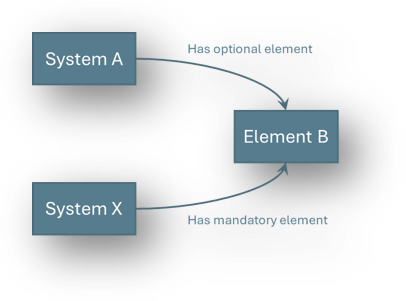
    Instead of defining special element types (e.g. “optional component”), IMPULS3 models such distinctions as relations between elements.
    For example, an element may be optional in one system and mandatory in another, without changing the definition of that element. This allows the same element to be reused consistently across multiple contexts, while maintaining full flexibility in how it is applied.

In IMPULS3, relationships such as mandatory or optional are modeled explicitly between elements, rather than embedded in the elements themselves.


Foundational Publications

PLM Integrated Requirements Management

Authors
Cees Michielsen, Jörg W. Fischer, Martin Rebel & Armin Haße

Publication
ZWF – Zeitschrift für wirtschaftlichen Fabrikbetrieb, Volume 107, Issue 3, March 2012, pp. 163–167.

DOI
10.3139/104.110717

Abstract

Product success depends heavily on how accurately customer requirements are understood throughout the product development lifecycle. Although considerable effort is often invested in writing high-quality requirements, many engineering errors still originate from differences in interpretation rather than from deficiencies in the wording itself.

This paper introduces SITIO (Securing Information Transformation from Input to Output), a method developed as part of a PLM-integrated Requirements Management approach. Rather than focusing exclusively on improving the quality of requirements documentation, SITIO addresses the quality of interpretation by applying principles from linguistic pragmatics to engineering communication.

By making the transformation of information between engineering disciplines explicit, SITIO reduces the risk of information loss and misinterpretation throughout distributed product development processes. The concepts presented in this publication later became one of the cornerstones of the IMPULS3 Requirements Engineering methodology, where preserving the meaning of engineering information is considered equally important as preserving the information itself.

Why this publication matters for IMPULS3

This publication marks the introduction of the SITIO concept—Securing Information Transformation from Input to Output. The central idea that engineering success depends not only on the quality of information, but also on preserving its intended meaning during every transformation, has become one of the fundamental principles of the IMPULS3 methodology.

Reference (APA 7th edition)

Fischer, J. W., Michielsen, C., Rebel, M., & Haße, A. (2012). PLM integrated requirements management: SITIO – An approach to PLM-integrated requirements communication in distributed product development processes using aspects of linguistic pragmatics. ZWF – Zeitschrift für wirtschaftlichen Fabrikbetrieb, 107(3), 163–167. https://doi.org/10.3139/104.110717

Enhancing Interpretation Quality of Requirements Using PLM Integrated Requirements Communication in Cross-Company Development Processes

Authors
Cees Michielsen, Jörg W. Fischer, Martin Rebel & Armin Haße

Publication
Proceedings of the DESIGN 2014 – 13th International Design Conference,
Dubrovnik, Croatia, May 2014.

Abstract

Product development increasingly takes place across organizational boundaries, involving OEMs, suppliers, engineering partners, and subcontractors. Although Product Lifecycle Management (PLM) systems effectively support the exchange of engineering information, they do not guarantee that this information is interpreted consistently by all parties involved.

This paper extends the SITIO (Securing Information Transformation from Input to Output) methodology to distributed product development environments. It demonstrates how linguistic pragmatics can be used to improve the interpretation quality of engineering information, thereby reducing misunderstandings, engineering errors, and costly rework.

The publication emphasizes that successful Requirements Engineering depends not only on the correctness of documented requirements but also on preserving their intended meaning as information moves between organizations. This concept later evolved into one of the central principles of the IMPULS3 methodology.

Why this publication matters for IMPULS3

This publication extends the original SITIO concept beyond a single organization and demonstrates how preserving the meaning of engineering information becomes even more important in distributed development environments involving multiple companies and engineering disciplines.

Reference (APA 7th edition)

Fischer, J. W., Michielsen, C., Rebel, M., & Haße, A. (2014). Enhancing interpretation quality of requirements using PLM integrated requirements communication in cross-company development processes. In Proceedings of the DESIGN 2014 – 13th International Design Conference (pp. 189–198). Design Society.

The Missing Link – Between Requirements and Design

Authors
Armin Haße & Cees Michielsen

Publication
Proceedings of the Posters Workshop at CSD&M 2013,
CEUR Workshop Proceedings, Volume 1085,
Paris, France, 2013.

Abstract

Traditional Requirements Engineering approaches generally establish traceability between higher-level and lower-level requirements. However, the engineering reasoning that explains why new requirements are introduced often remains implicit. As a result, important design rationale is easily lost during system decomposition and product development.

This paper introduces the concept of the Missing Link between Requirements Engineering and Design Engineering. Rather than deriving lower-level requirements directly from higher-level requirements, the paper proposes making the intermediate engineering reasoning explicit by introducing Design Decisions as independent information objects.

Capturing this missing engineering information improves traceability, preserves engineering rationale, supports impact analysis, and provides a transparent justification for derived requirements throughout the system lifecycle.

Why this publication matters for IMPULS3

This publication introduced one of the most fundamental concepts of the IMPULS3 methodology: the explicit separation between Requirements Engineering and Design Engineering by introducing Design Decisions as first-class engineering information objects. The paper laid the foundation for preserving engineering reasoning throughout the development process.

Reference (APA 7th edition)

Haße, A., & Michielsen, C. (2013). The missing link – Between requirements and design. In Proceedings of the Posters Workshop at CSD&M 2013 (CEUR Workshop Proceedings, Vol. 1085, pp. 59–74).

Design Decisions – The Missing Link

Authors
Cees Michielsen & Armin Haße

Publication
Tag des Systems Engineering 2014,
German Chapter of INCOSE (GfSE),
Carl Hanser Verlag, Munich, Germany, 2014.

Abstract

Systems Engineering requires that engineering decisions remain understandable long after they have been made. While requirements describe what a system must achieve, they generally do not explain why particular design solutions have been selected. This missing engineering rationale often results in incomplete traceability, difficult impact analysis, and unnecessary redevelopment effort.

This publication introduces Design Decisions as explicit engineering information objects that document the evaluation of Design Options and the rationale behind selecting a particular solution. Design Decisions provide the missing semantic connection between Requirements Engineering and Design Engineering.

By explicitly recording design rationale, engineering organizations can improve traceability, preserve engineering knowledge, support configuration management, and significantly simplify future system evolution.

Why this publication matters for IMPULS3

This publication further developed the concepts introduced in “The Missing Link” by formalizing Design Decisions as independent engineering information objects. The ideas presented here directly evolved into the Design Challenge, Design Option, and Design Decision concepts that are now central to the IMPULS3 information model.

Reference (APA 7th edition)

Michielsen, C., & Haße, A. (2014). Design Decisions – The Missing Link. In Tag des Systems Engineering 2014. Munich, Germany: Carl Hanser Verlag. Published by the German Chapter of INCOSE (GfSE).

Key References

International Council on Systems Engineering (INCOSE). (2023). Systems engineering handbook: A guide for system life cycle processes and activities (5th ed.). Wiley.
https://www.incose.org/products-and-publications/se-handbook

NASA. (2007). NASA systems engineering handbook (Rev. 1, NASA/SP-2007-6105). National Aeronautics and Space Administration.
https://www.nasa.gov/seh/handbook/

ISO/IEC/IEEE. (2015). ISO/IEC/IEEE 15288:2015 Systems and software engineering—System life cycle processes. ISO.
https://www.iso.org/standard/63711.html

ISO/IEC/IEEE. (2018). ISO/IEC/IEEE 29148:2018 Systems and software engineering—Life cycle processes—Requirements engineering. ISO.
https://www.iso.org/standard/72089.html

Pohl, K. (2010). Requirements engineering: Fundamentals, principles, and techniques. Springer.
https://doi.org/10.1007/978-3-642-12578-0

Hull, E., Jackson, K., & Dick, J. (2011). Requirements engineering (3rd ed.). Springer.
https://doi.org/10.1007/978-1-84996-405-0

Sommerville, I. (2016). Software engineering (10th ed.). Pearson.

Dijkstra, E. W. (1972). The humble programmer. Communications of the ACM, 15(10), 859–866.
https://doi.org/10.1145/355604.361591

Gilb, T. (2005). Competitive engineering: A handbook for systems engineering, requirements engineering, and software engineering using Planguage. Elsevier Butterworth-Heinemann.

Robertson, S., & Robertson, J. (2012). Mastering the requirements process: Getting requirements right (3rd ed.). Addison-Wesley.

Cabrera, D., & Cabrera, L. (2015). Systems thinking made simple: New hope for solving wicked problems. Odyssean Press.
https://doi.org/10.13140/RG.2.1.4338.9286
Cabrera, D., Colosi, L., & Lobdell, C. (2008). Systems thinking. Evaluation and Program Planning, 31(3), 299–310.
https://doi.org/10.1016/j.evalprogplan.2007.12.001

Credits

The work of Tom Gilb has strongly influenced the emphasis on quantification of system properties, while the contributions of Suzanne and James Robertson have informed practical approaches to Requirements Engineering. The Systems Thinking framework of Derek and Laura Cabrera, particularly the DSRP model, has provided valuable insights into structuring complexity through distinctions, systems, relationships, and perspectives.

Loading