How can a fast-growing company continue accepting exciting new projects without losing operational control?
A story about operational reality, hidden complexity, and confident decision-making.
the story
Employees
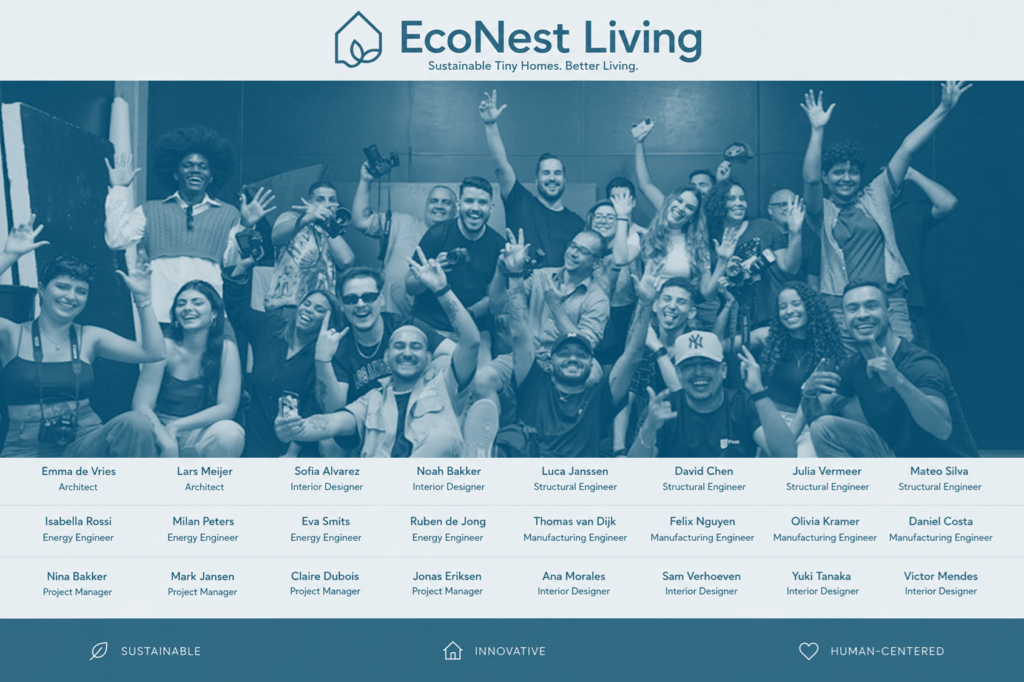
When Eco Nest Living started one year ago, the entire company consisted of only a handful of people working together in a small workshop.
An architect worked side-by-side with structural engineers. Interior designers discussed layouts directly with manufacturing specialists. Everyone knew exactly what the others were working on.
At that stage, planning was simple. But as new projects arrived, the company slowly began to change.
Different tiny house concepts required different expertise. Some projects demanded advanced solar integration, while others focused more on modular construction or compact interior design.
The same people were suddenly needed in multiple places at the same time.
An engineer helping finalize the Solar Haven project might also be needed for the next Urban Nest proposal.
An interior designer working on customer changes could delay manufacturing preparation for another project.
As the company continues to grow, keeping track of people, competences, availability, and project commitments becomes increasingly important.
Projects
After delivering their first three tiny house projects, Eco Nest Living started attracting much more attention than the founders had originally expected.
The company successfully completed:
- GreenWood Holiday Park,
- Rotterdam Urban Pilot,
- and the Solar Valley Demonstrator.
Each project focused on a different tiny house concept and introduced new technical and operational challenges.
The GreenWood Holiday Park project focused on compact eco-tourism cabins placed in natural surroundings.
The Rotterdam Urban Pilot explored sustainable urban living in a dense city environment.

The Solar Valley Demonstrator pushed the company further into off-grid energy systems and advanced solar integration.
With every completed project, the company gained experience, visibility, and new opportunities. But the growing number of customer requests also made planning increasingly complex.
Different projects required different competences, schedules, suppliers, and manufacturing activities.
An engineer helping finalize one project could already be needed for the next proposal.
A delay in manufacturing preparation could immediately affect installation planning for another customer.
What once fit on a simple planning board was slowly evolving into a network of overlapping projects, people, and dependencies.
Product Domains
As Eco Nest Living continued to grow, the company gradually expanded from a single tiny house concept into a small portfolio of specialized product types.

Family Flex
Some customers preferred compact nature cabins such as the Forest Pod, while others were more interested in urban living concepts like the Urban Nest or energy-independent solutions such as the Solar Haven.

NomadOne
Each product domain introduced its own technical characteristics, customer expectations, and engineering challenges.

Forest Pod
A project focused on off-grid living required very different expertise than a project centered around modular family housing or compact city living.

Solar heaven
Over time, the product domains became an important way to structure knowledge, competences, project experience, and future development activities across the company.
Urban Nest
Activities
Every tiny house project at Eco Nest Living consists of a sequence of activities that must be performed in the right order by people with the right competences.
A new project often starts with architectural design activities, where architects and interior designers translate customer wishes into an initial concept.
Once the overall layout has been approved, structural engineers begin working on construction details, safety calculations, and modular building structures.
For projects such as the Solar Haven, energy specialists are needed to design solar integration, battery systems, and smart energy management solutions.
At the same time, manufacturing specialists prepare production activities, material planning, supplier coordination, and assembly sequences.
Some activities can run in parallel, while others depend completely on earlier work being finished first.
This means that delays in one activity can quickly affect many other activities further downstream.
Competences play a central role throughout the entire process.
An activity cannot simply be assigned to any available employee.
It requires people with the specific expertise needed for that particular task.
As more projects run simultaneously, the company gradually becomes a network of interconnected activities, dependencies, and competences spread across multiple teams and timelines.
falcon
Employees
In Falcon, employees are more than just names in a planning sheet.
Each employee is connected to:
- a function,
- one or more competences,
- an organizational team,
- a contract period,
- and a weekly availability schedule.
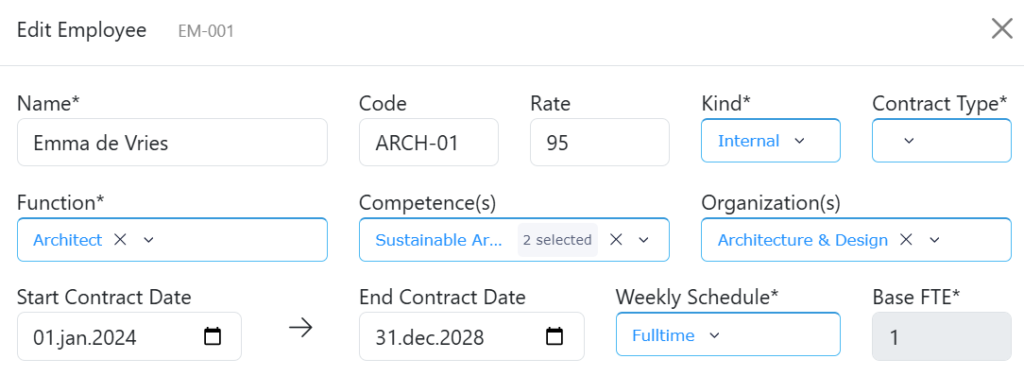
This allows Falcon to understand not only who is available, but also whether the employee has the right expertise for a specific activity or project.
For example, Emma de Vries is an architect within the Architecture & Design team. She specializes in sustainable architecture and is available fulltime during her contract period.
As Eco Nest Living grows and more projects run simultaneously, this information becomes essential for making realistic planning decisions and preventing bottlenecks before they occur.
Projects
In Falcon, projects are visualized across time.
The graph shows both:
- committed projects that the company has already accepted,
- and prospect projects that are still under consideration.
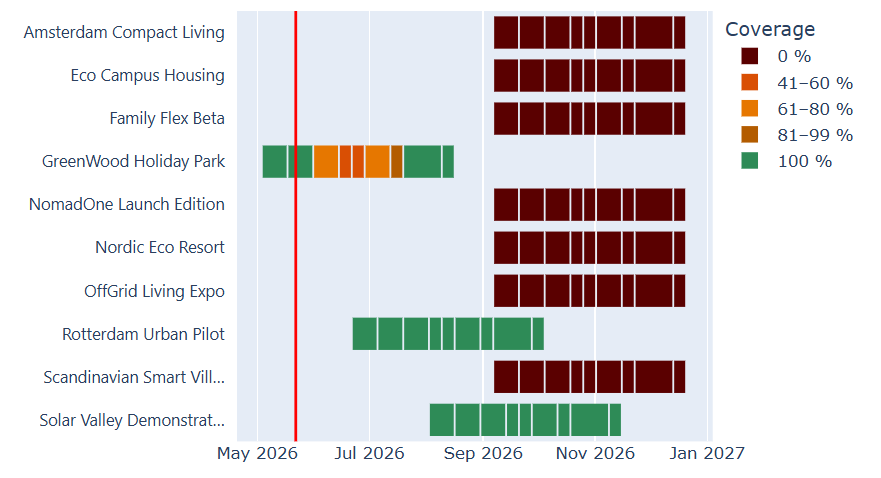
The three committed projects are already partially or fully matched to employees with the required competences. These projects appear green when Falcon can successfully match the required activities with the available employees.
The prospect projects are not yet planned in detail. They are shown in red because Falcon has not yet matched the required activities to available resources.
This allows Eco Nest Living to immediately see:
- which projects are already covered,
- where future capacity shortages may appear,
- and how new opportunities could affect ongoing work.
As the company grows, this overview becomes increasingly important for making realistic decisions about which projects can safely be accepted.
Project information
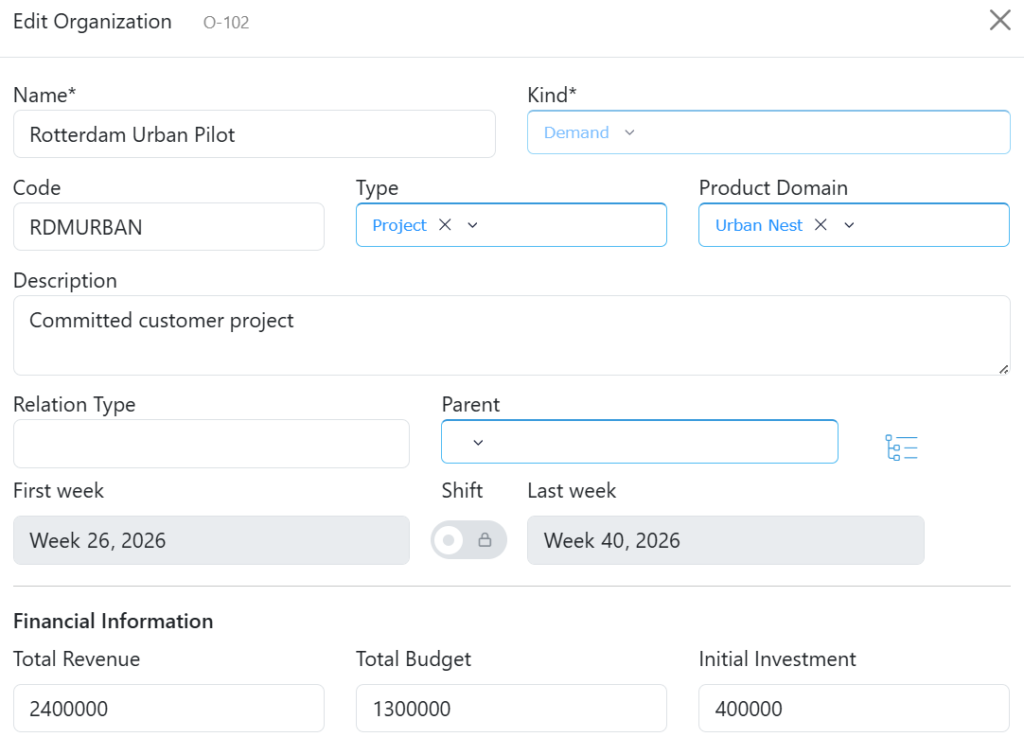
Each project contains information such as:
- the project name,
- project type,
- associated product domain,
- project duration,
- financial information,
- and relationships to other organizational elements.
This helps Eco Nest Living maintain a clear overview of both committed and prospect projects.
For example, the Rotterdam Urban Pilot project belongs to the Urban Nest product domain and runs from week 26 until week 40 in 2026.
Falcon also allows the company to estimate:
- expected revenue,
- available budget,
- and required investments.
As more projects are added, this information becomes essential for understanding how new opportunities may affect:
- planning,
- staffing,
- manufacturing capacity,
- and financial risk across the organization.
Product Domains
In Falcon, product domains help organize projects, activities, competences, and experience around specific product families.
For Eco Nest Living, each tiny house type represents its own product domain, such as:
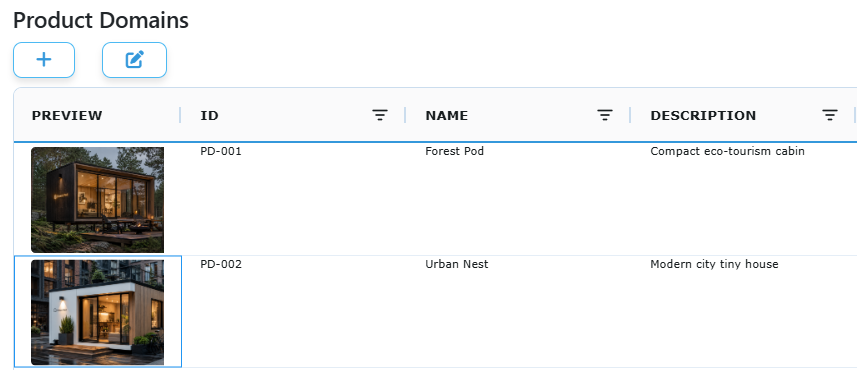
- Forest Pod,
- Urban Nest,
- Solar Haven,
- Family Flex,
- and Nomad One.
Although the tiny houses share many similarities, each product domain also introduces its own:
- technical characteristics,
- engineering challenges,
- customer expectations,
- and required competences.
For example, projects within the Solar Haven domain place a stronger focus on solar integration and smart energy systems, while Urban Nest projects emphasize compact city living and space optimization.
Activities
In Falcon, activities describe the actual work that needs to be performed within a project.
Each activity is connected to:
- a project,
- a required competence,
- a planning period,
- and the amount of capacity needed over time.
For example, the activity shown here represents the architectural design phase of the GreenWood Holiday Park project.
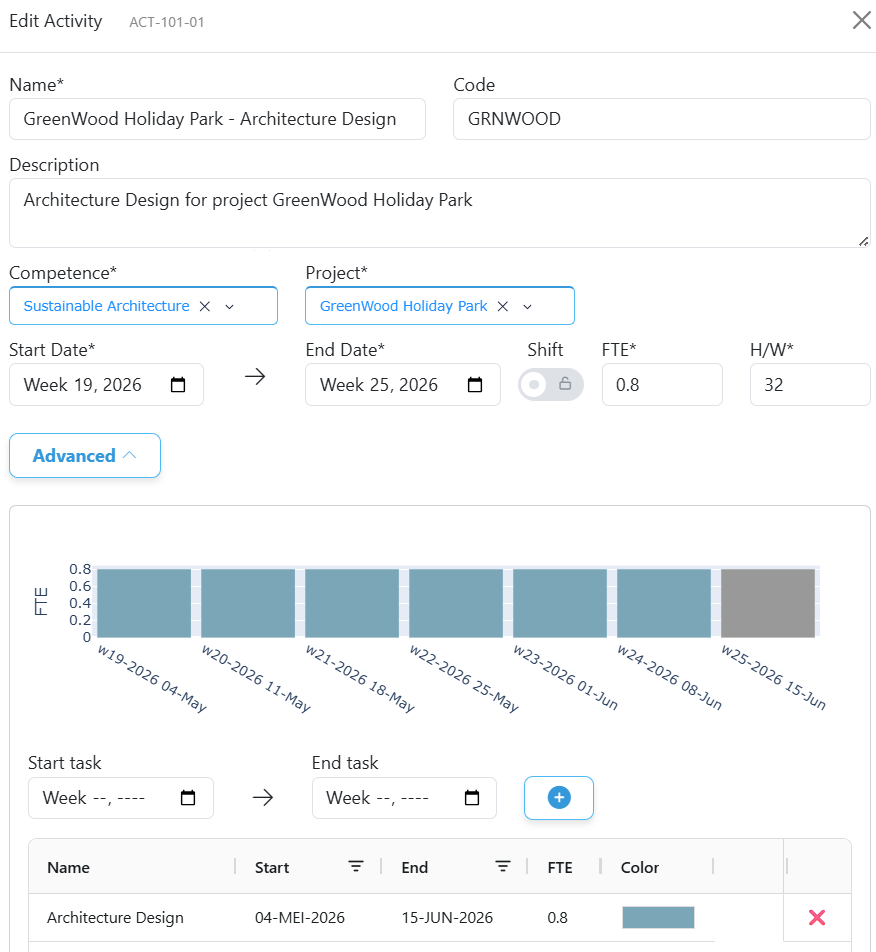
This activity requires the competence Sustainable Architecture and is planned across multiple weeks with a required capacity of 0.8 FTE.
Activities can also be divided into smaller tasks with their own:
- timelines,
- workload,
- and visual color coding.
This helps Eco Nest Living understand:
- what work must be performed,
- when it must happen,
- and which competences are required throughout the project lifecycle.
Because activities are directly connected to competences, Falcon can later match them to employees with the appropriate expertise and availability.
Matching
In the beginning, project planning at Eco Nest Living was mostly done through spreadsheets, meetings, and personal communication.
When a new activity appeared, the team would simply look around and ask:
“Who is available?”
“Who worked on something similar before?”
“Can somebody still take this on?”
This worked reasonably well while the company only handled one or two projects at the same time.
But as more projects started running in parallel, the situation became increasingly difficult to oversee.
The same engineer could unknowingly be planned for multiple activities in overlapping periods.
Specialized competences, such as solar integration or modular construction, became difficult to track across projects.
Some employees became overloaded, while others remained underutilized.
Planning discussions also became more dependent on assumptions and individual memory.
A project manager might believe somebody was still available, while another team had already reserved the same person for upcoming work.
As the number of projects, activities, and dependencies continued to grow, manually matching people to activities slowly became one of the biggest operational challenges inside the company.
Matching
Falcon helps Eco Nest Living understand whether a new project can realistically be accepted before committing to it.
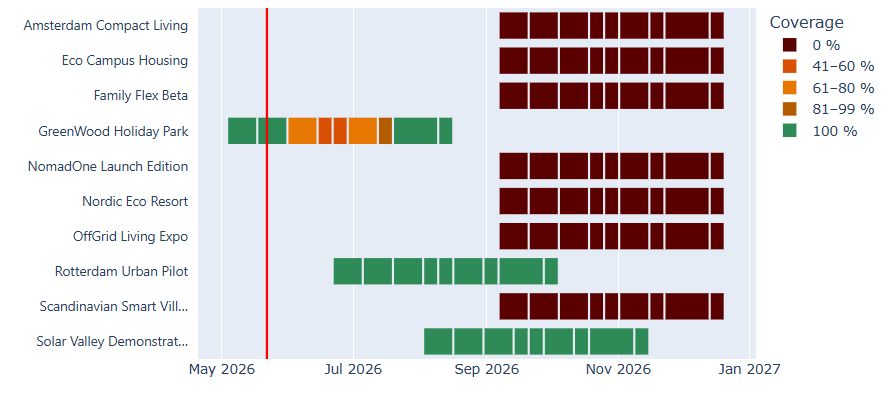
In the overview above, the three committed projects have already been matched to employees with the required competences. The seven prospect projects are still unmatched and therefore appear red.
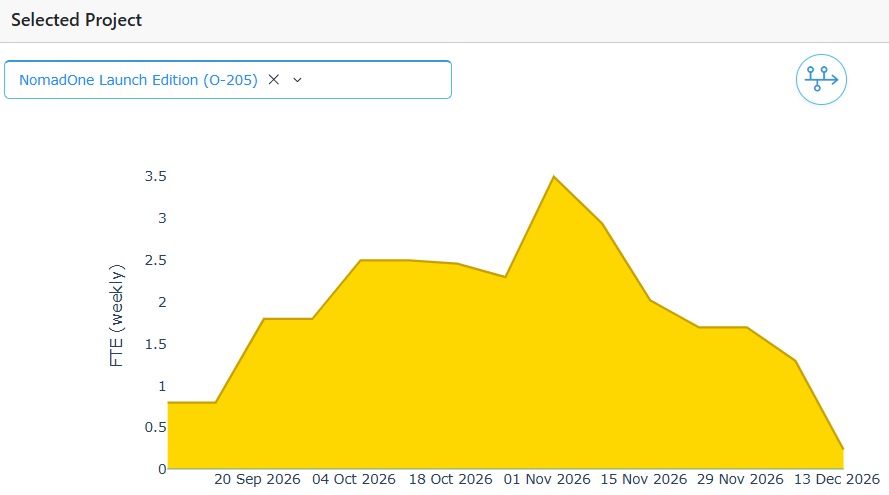
Suppose the company wants to investigate the NomadOne Launch Edition project.
Falcon first shows the expected workload of the project across time. This immediately gives insight into:
- when the project requires the most capacity,
- how long the project will run,
- and where the highest staffing pressure will occur.

Using the “Find Optimal Start Date” function, Falcon can then evaluate alternative starting moments for the project within a selected time window.
Using the “Find Optimal Start Date” function, Falcon can then evaluate alternative starting moments for the project within a selected time window.
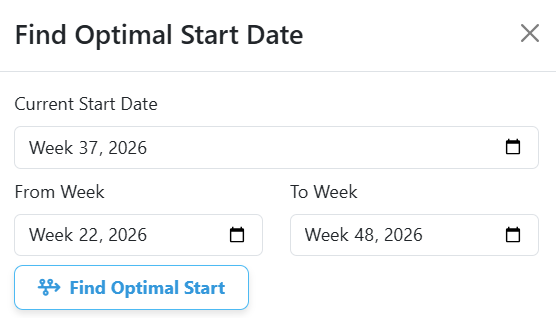
Instead of manually shifting projects around in spreadsheets, Falcon automatically analyzes how different start dates affect:
- competence availability,
- employee workload,
- and overlap with other ongoing projects.
In this example, Falcon determines a better starting position for the NomadOne Launch Edition project.
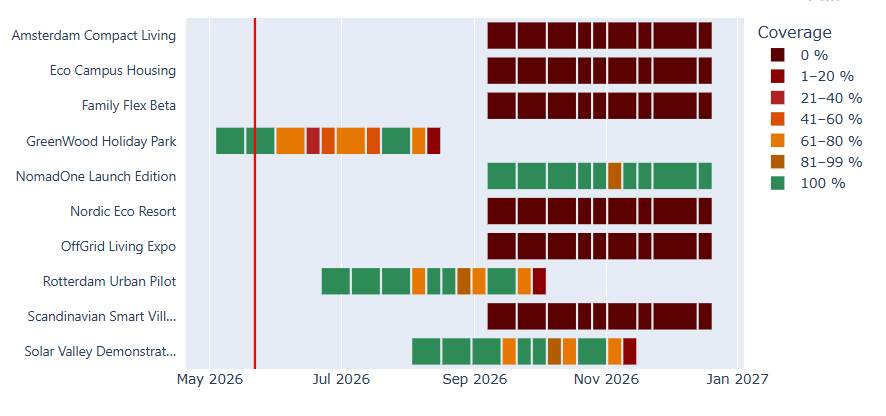
After matching, the project changes from fully unmatched to mostly green, meaning that the required activities can now largely be covered by employees with the appropriate competences and availability.
This helps Eco Nest Living make more realistic decisions before accepting new customer commitments.
Reporting
As Eco Nest Living continued to grow, communication inside the company gradually became more important — and more difficult.
In the early days, most decisions were made informally.
People discussed priorities directly in the workshop.
Everyone knew which projects were running and who was working on what.
But once multiple projects started overlapping, this became increasingly difficult to manage.
Project managers needed regular updates about planning progress.
Engineers wanted to understand how delays in one activity affected other projects.
Management needed visibility into workload, staffing pressure, budgets, and future risks.
Customers also expected clearer communication and more reliable commitments.
Questions such as:
- “Can we still deliver on time?”
- “Why did this activity move?”
- “Which projects are affected?”
- “Do we still have enough engineering capacity?”
became part of daily operations.
As a result, the company started relying more heavily on structured reporting, shared planning information, and transparent decision-making.
The ability to explain and justify planning decisions gradually became just as important as making the decisions themselves.
Reporting
As Eco Nest Living continued to grow, different people inside the company needed different kinds of information to make decisions and coordinate their work.
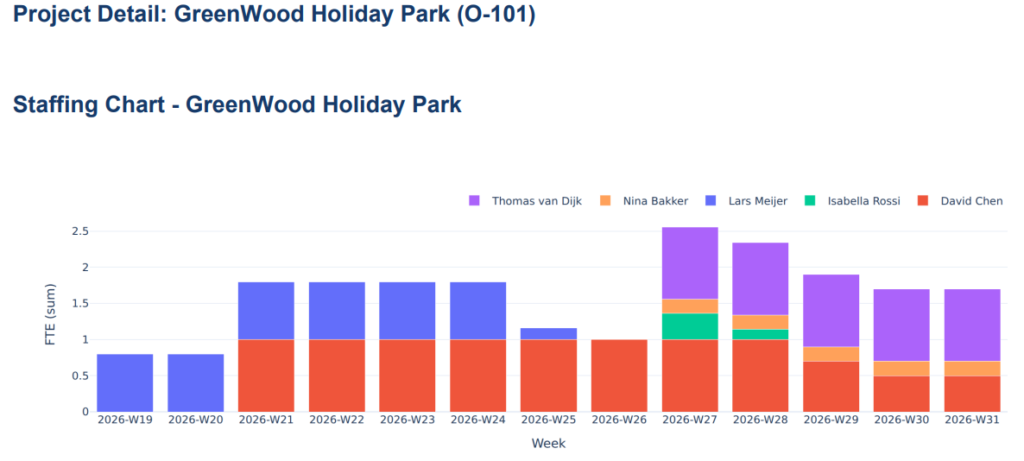
Falcon supports this by providing reporting and insight functions tailored to different operational roles across the organization.
Opportunity Management
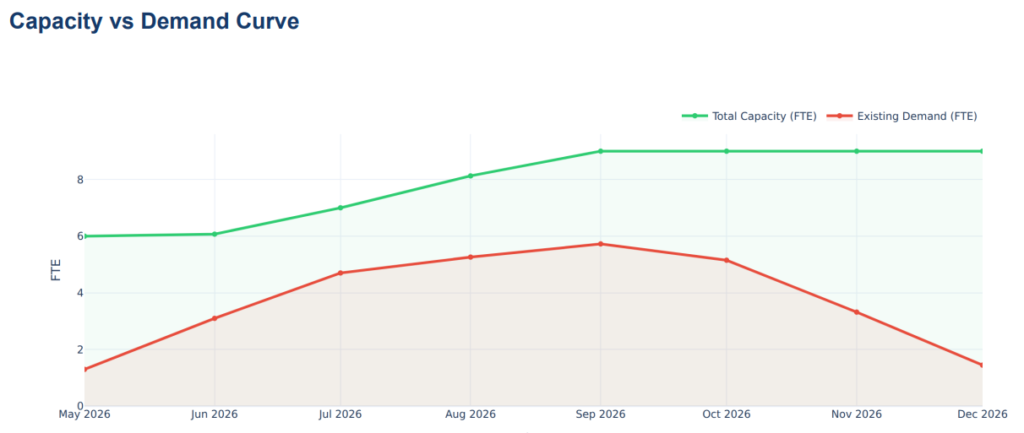
Opportunity managers want to understand whether a new project can realistically be accepted.
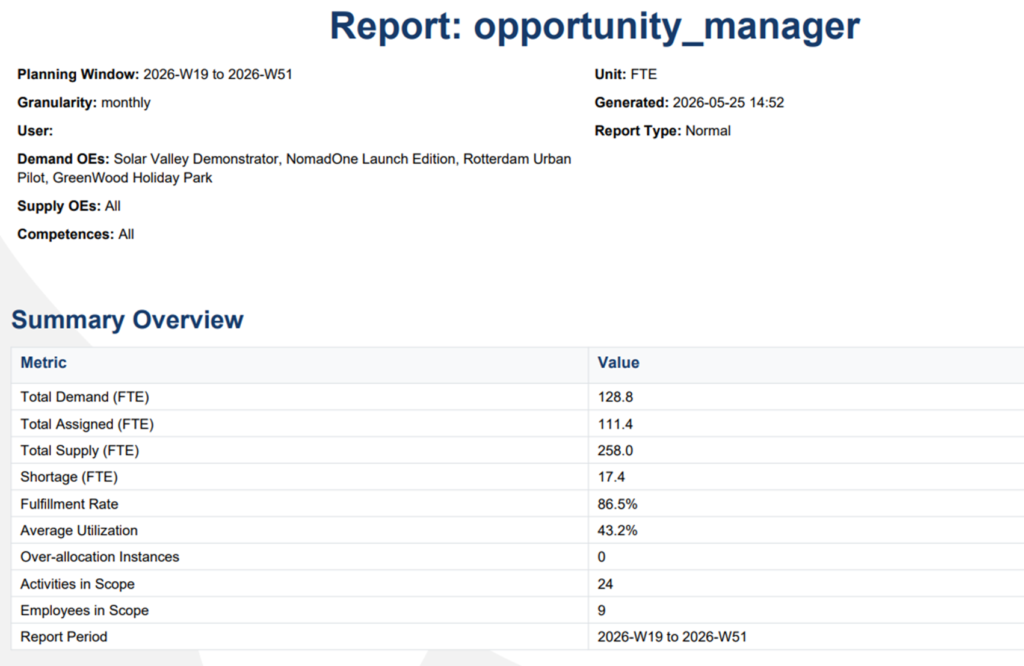
They use Falcon to evaluate:
- available capacity,
- competence shortages,
- project overlap,
- and alternative start dates before making customer commitments.
Head of Engineering
Engineering management needs visibility into:
- technical workload,
- engineering bottlenecks,
- activity dependencies,
- and competence utilization across projects.
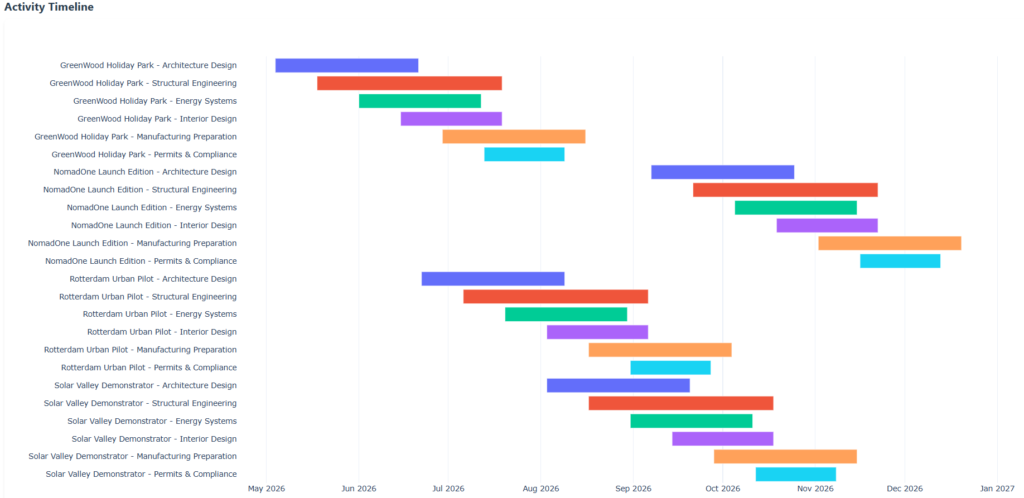
This helps prevent critical specialists from becoming overloaded.
Human Resource Management
HR focuses on:
- employee availability,
- staffing pressure,
- contract periods,
- recruitment needs,
- and long-term workforce planning.
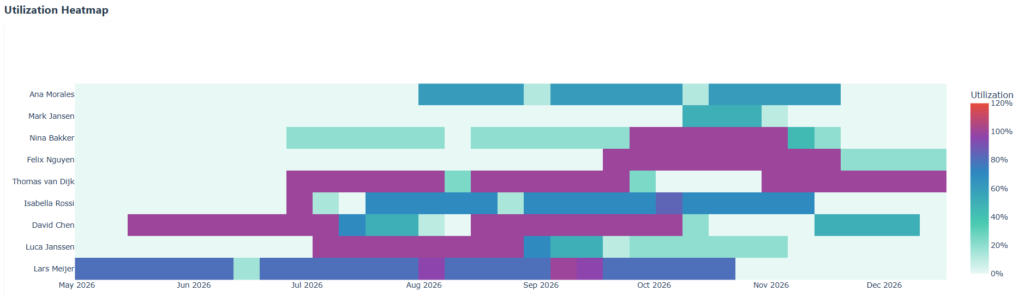
Falcon helps identify where additional capacity or external support may be required.
Competence Management
Competence managers use Falcon to understand:
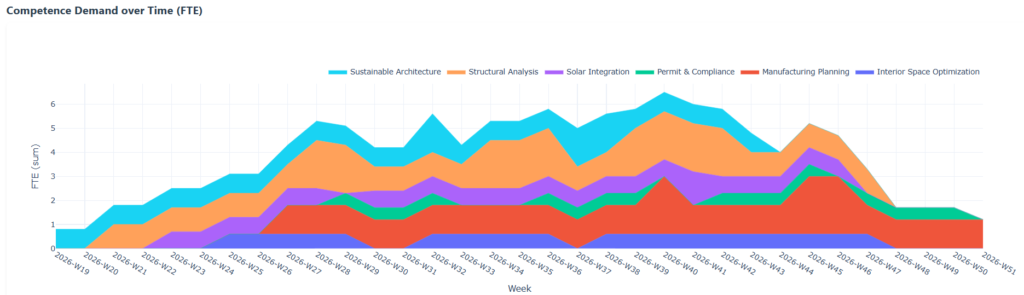
- which competences are heavily used,
- where knowledge gaps exist,
- and which expertise areas are becoming strategically important as the company grows.
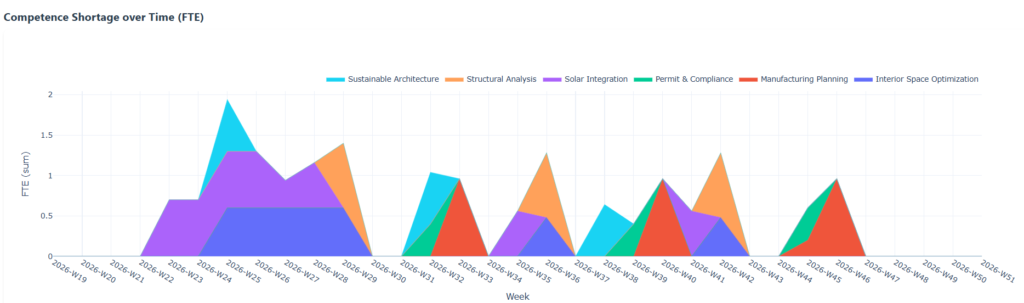
This supports training, hiring, and long-term capability development.
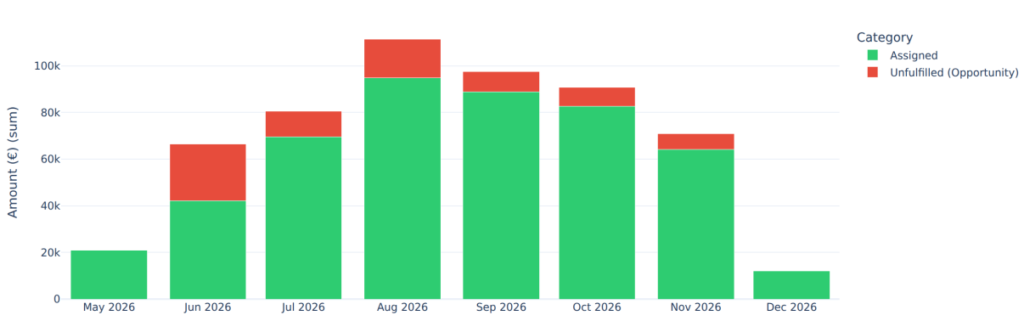
Head of Finance
Finance management needs insight into:
- project timing,
- investment planning,
- staffing costs,
- budget utilization,
- and the operational consequences of delays or resource shortages.
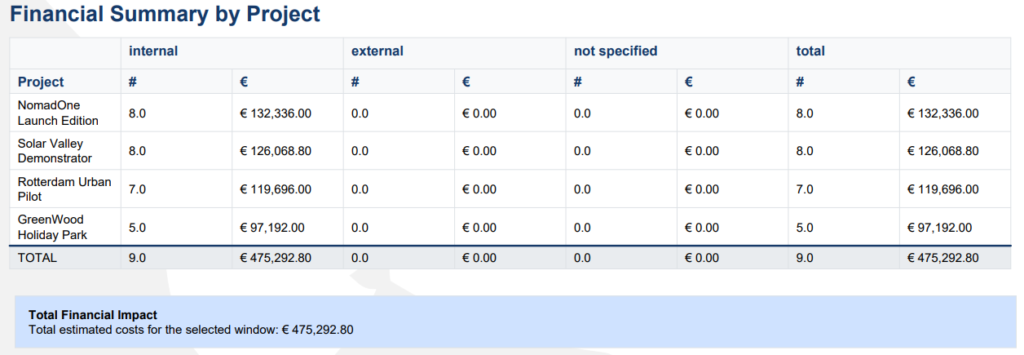
Because projects, activities, people, and timelines are connected inside Falcon, the company can create a shared operational picture across multiple departments and decision makers.
Start flying!