
IMPULS3 · Cross-Cutting Process
Quality Management
 Quality Management
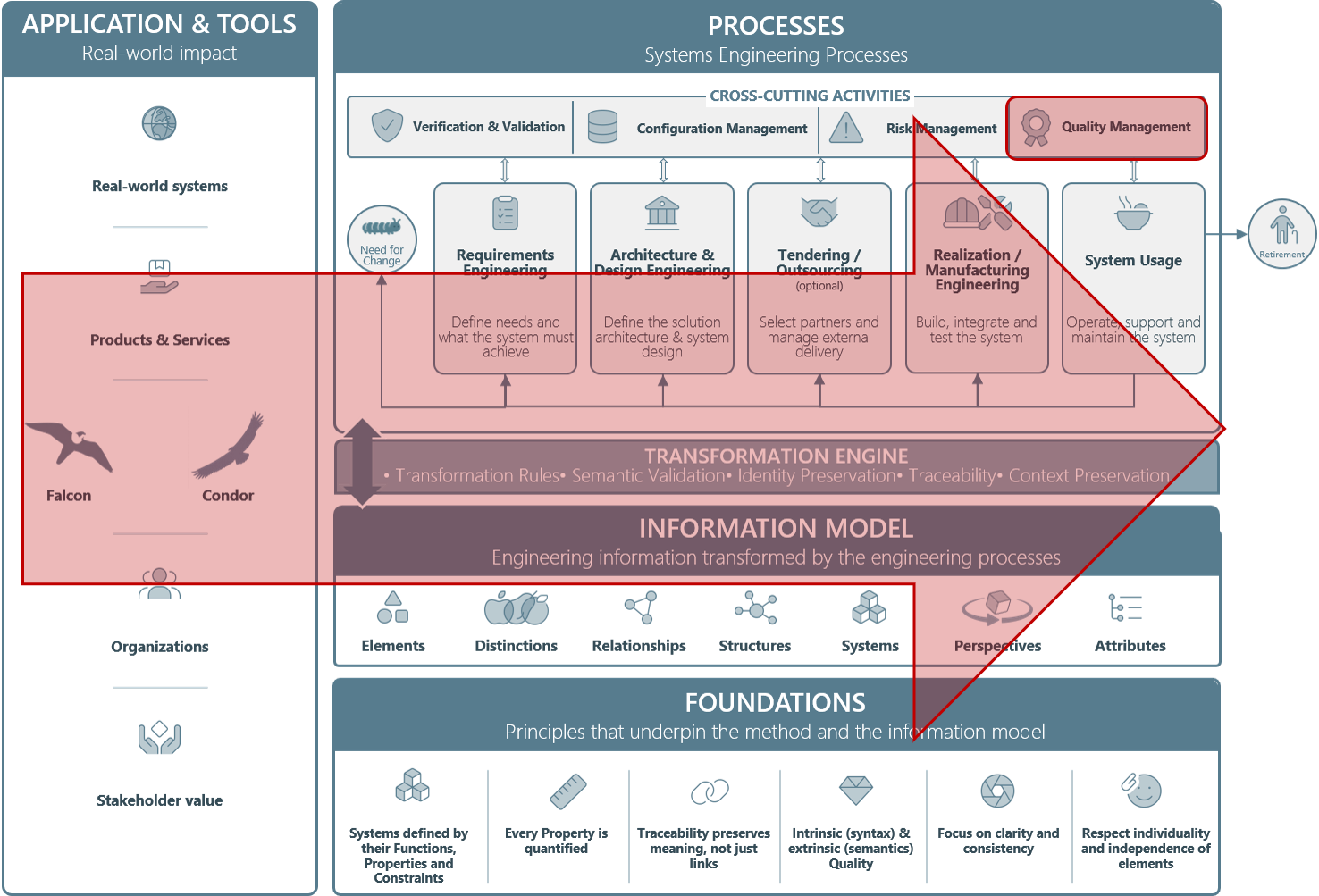
IMPULS3 Quality Management ensures that engineering processes are capable of producing reliable engineering information, and that the resulting information elements are fit for their intended purpose.
Quality Management is a cross-cutting process. It applies throughout the engineering lifecycle and to every engineering process. Quality is therefore not something that is checked only at the end; it is built into the way engineering work is performed and information is created, transformed and used.
Two complementary perspectives
 Quality Assurance
- Focuses on how engineering work is performed
- Defines methods, criteria and controls
- Prevents defects before they occur
- Provides confidence in process capability
 Quality Control
- Focuses on the engineering information produced
- Checks information against defined criteria
- Detects defects and inconsistencies
- Confirms fitness for intended purpose
Together, Quality Assurance and Quality Control provide confidence that engineering information is reliable, consistent and fit for purpose.
Quality is built into both the process and the information it produces.
Quality Management · Purpose
Purpose
 Purpose
The purpose of Quality Management is to establish confidence that engineering processes and engineering information are sufficiently reliable to support sound engineering decisions.
IMPULS3 treats quality as an integral part of engineering. Quality criteria are established explicitly, applied throughout the engineering lifecycle and used to evaluate both the way engineering work is performed and the information it produces.
 Confidence
 Improvement
Quality is not an abstract property: it is the degree to which engineering information and the processes that produce it are suitable for their intended purpose.
Quality Management · Continuous Cycle
The Quality Management Cycle
 The Quality Management Cycle
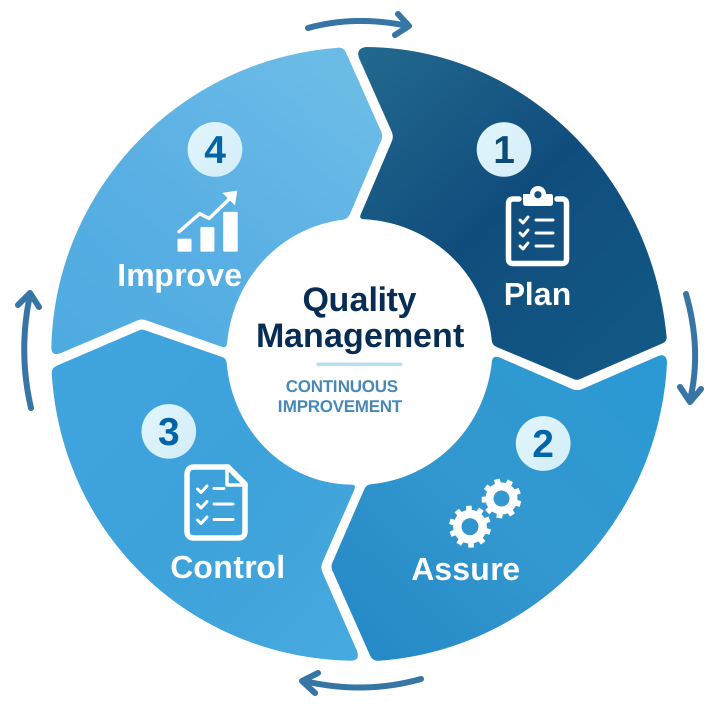
IMPULS3 Quality Management is a continuous cycle of planning, assurance, control and improvement.
The cycle builds on the principle of continuous improvement underlying the Plan–Do–Check–Act (PDCA) approach to quality management: quality objectives and criteria are established, engineering work is performed under controlled conditions, results are evaluated, and findings are used to improve subsequent work.[1]
 1 · Plan
Define quality objectives, criteria, responsibilities, methods and required evidence.
Ensure that engineering processes, methods and controls are capable of producing reliable results.
Evaluate engineering information against defined quality criteria and identify deviations.
Use findings and experience to improve engineering information, methods, controls and processes.
The cycle does not end with improvement. Findings, lessons learned and changed circumstances become input to the next planning cycle. Quality Management therefore continuously adapts as engineering information, processes and the system itself evolve. [ISO9001-2026]
Plan → Assure → Control → Improve → Plan again.
Quality Management · Information Quality
SITIO
 SITIO
SITIO — Securing Information Transformation from Input to Output ensures that engineering information retains its intended meaning and quality as it moves through the engineering lifecycle.
Engineering information is continuously transformed: from source information into needs, from needs into analysis, from analysis into requirements, and from requirements into design and verification. Every transformation introduces the possibility that information is misunderstood, distorted, weakened or lost.
SITIO addresses this risk by considering both the [[intrinsic quality]] of an Information Element and its [[extrinsic quality]] in relation to its context, source and intended use. [RebelFischerHasseMichielsen2013]
Three perspectives on information quality
 Conformance
Engineering information must conform to its source, agreed decisions and applicable criteria. Meaning must be preserved when information is transformed.
Engineering information must be suitable for the people, processes and activities that depend on it as input for subsequent engineering work.
 Craftsmanship
Engineering information must satisfy the applicable rules, conventions and professional standards for the Information Element being produced.
These perspectives are complementary. An Information Element may be well structured but express the wrong meaning, or correctly represent its source while being unusable by the next engineering process. Good information quality requires both semantic integrity and appropriate craftsmanship.
Information quality must survive transformation.
Quality Management · Quality Control
Reviews as a Quality Control Mechanism
 Reviews as a Quality Control Mechanism
Reviews provide a structured mechanism for assessing the quality of engineering information before it is accepted, released, or used as input for subsequent engineering work.
Within IMPULS3, a review is not merely a meeting in which several people look at an Information Element. It is a deliberate Quality Control activity in which an Information Element is assessed against explicit quality criteria, defects are identified and recorded, and the results are followed through to an agreed disposition.
Reviews may address both [[Intrinsic Quality]] and [[Extrinsic Quality]]. Intrinsic Quality is considered by examining whether the Information Element itself is clear, consistent, sufficiently complete, well structured and compliant with applicable rules. Extrinsic Quality requires reviewers to consider its relationship with its source, stakeholder needs, intended use and the engineering activities that depend on it.
A review is a process, not an event
Effective reviews require more than bringing knowledgeable people together. The work must be prepared, the purpose and assessment criteria must be understood, reviewers need sufficient time to examine the information, findings must be recorded, and identified defects must be resolved and followed up.
This disciplined view of reviewing is strongly reflected in the inspection method described by Tom Gilb and Dorothy Graham in Software Inspection [GilbGraham1993]. Although developed in a software-engineering context, the underlying principles are equally applicable to requirements, models, analyses, specifications and other engineering Information Elements.
Roles make the review effective
A structured review benefits from explicit roles. Gilb and Graham emphasize the importance of separating responsibility for the work product from responsibility for the inspection process [GilbGraham1993]. In particular, the moderator plays a crucial role in preparing and controlling the review.
The moderator prepares the review, confirms that the Information Element is ready to be reviewed, selects or coordinates the participants, explains the method and criteria, facilitates the review and ensures that findings are recorded and followed through.
The author provides the material and necessary context, answers questions of fact and performs the agreed rework. The review should assess the Information Element rather than the person who created it.
Reviewers contribute relevant knowledge and perspectives and examine the Information Element against the applicable criteria. Different reviewers may deliberately adopt different perspectives.
The recorder captures defects, questions, decisions and actions in a form that allows them to be dispositioned and followed through to closure.
Checklists turn experience into repeatable Quality Control
Checklists are particularly valuable because they preserve knowledge gained from previous reviews and make that knowledge available to the next reviewer. A good checklist does not replace engineering judgement; it directs attention towards defect classes that experience has shown to be important [GilbGraham1993].
In IMPULS3, checklists should therefore be specific to the type and maturity of the Information Element. A [[Requirement]] may be examined for ambiguity, quantification and verifiability, while an Analysis Statement may require greater attention to reasoning, source information, assumptions and preservation of stakeholder intent. The applicable quality criteria should follow the Information Element rather than be imposed as one universal checklist.
The output of a review is evidence
A review is not complete simply because the meeting has ended. Its outcome should provide evidence of what was assessed, against which criteria, by whom, which defects were identified, how they were dispositioned and whether the required corrections were completed. NASA similarly treats peer reviews as planned technical activities with defined entrance and success criteria and explicit treatment of identified defects [NASA2016].
This makes the review result part of the engineering information itself. It provides evidence that Quality Control has taken place and supports the decision to accept, revise, release or reject the Information Element.
A review does not create quality by inspection; it provides evidence of quality and identifies where corrective action is required.
A critical note
“Program testing can be used to show the presence of bugs, but never to show their absence!”
— Edsger W. Dijkstra, Notes on Structured Programming
Dijkstra made this observation about program testing, but the same limitation applies to engineering reviews. A review can demonstrate the presence of defects in an Information Element; failure to find defects does not demonstrate their absence. Review results therefore provide evidence about quality, not proof of defect-free information. [Dijkstra1970]
 References