
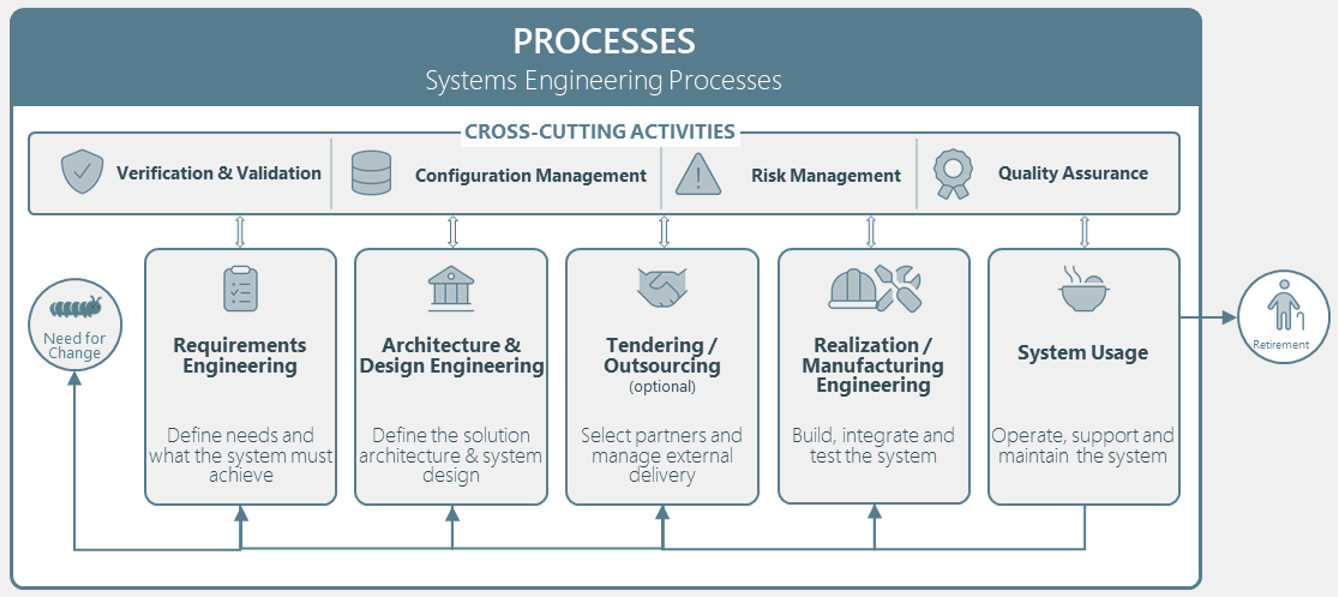
The Processes layer of the IMPULS3 Framework defines the core Systems Engineering activities that transform stakeholder needs into operational systems and services.
These processes do not operate independently. Together, they continuously create, refine, validate, and evolve a single, consistent information model throughout the system lifecycle.
The lifecycle starts with a Need for Change and ends with Retirement, while operational feedback continuously drives learning and improvement.
The role of the processes
Each process contributes a specific type of knowledge and decision-making to the evolving system definition:
| Process | Primary focus |
|---|---|
| Requirements Engineering | Understanding what the system must achieve |
| Architecture & Design Engineering | Defining how the system will fulfill those needs |
| Tendering / Outsourcing Engineering | Managing external realization and supplier interaction |
| Realization / Manufacturing Engineering | Building, integrating, and testing the system |
| System Usage | Operating, maintaining, and improving the system in practice |
Rather than creating isolated deliverables, the processes continuously interact with and evolve the shared information model.
Need for Change
Every system lifecycle starts with a perceived need for change.
This may originate from:
- operational problems,
- new stakeholder expectations,
- technological opportunities,
- changing legislation,
- business objectives,
- or lessons learned from existing systems.
The Need for Change initiates the Systems Engineering processes and provides the initial motivation and context for system development or modification.
Requirements Engineering
Requirements Engineering focuses on understanding stakeholder needs and translating them into clear, consistent, and verifiable system requirements.
This process establishes:
- what the system must do,
- which properties it must possess,
- and under which constraints it must operate.
Within IMPULS3, Requirements Engineering places strong emphasis on:
- traceability,
- quantification,
- consistency,
- and preservation of meaning.
The output of this process forms the foundation for all subsequent engineering activities.
Architecture & Design Engineering
Architecture & Design Engineering defines the structural and behavioral solution for the system.
This includes:
- decomposition into subsystems and elements,
- allocation of functions and responsibilities,
- definition of interfaces and interactions,
- and development of the overall system architecture.
In IMPULS3, architectures are represented explicitly within the information model, ensuring that relationships and dependencies remain traceable and consistent.
Tendering / Outsourcing Engineering (optional)
In some projects, parts of the system are realized by external suppliers or partners.
This process focuses on:
- preparing technical specifications,
- evaluating supplier proposals,
- managing contractual alignment,
- and maintaining consistency between internal and external system definitions.
Because outsourcing is not applicable to every organization or project, this process is modeled as optional within the framework.
Realization / Manufacturing Engineering
Realization / Manufacturing Engineering transforms the defined architecture and design into a physical or operational system.
This includes:
- implementation,
- integration,
- assembly,
- manufacturing,
- testing,
- and verification activities.
The purpose of this process is not only to build the system, but also to confirm that the realized solution conforms to the intended system definition.
System Usage
System Usage represents the operational phase of the lifecycle.
During this phase, the system is:
- operated,
- used,
- maintained,
- supported,
- monitored,
- and evaluated in real-world conditions.
Operational experience often reveals:
- new stakeholder needs,
- unforeseen constraints,
- improvement opportunities,
- and changing operational contexts.
As a result, System Usage frequently generates new Needs for Change, creating a continuous improvement loop throughout the lifecycle.
Cross-cutting activities
Several activities apply continuously across all engineering processes:
Verification & Validation
Ensuring that the system definition and realized system satisfy stakeholder needs and intended use.
Configuration Management
Maintaining consistency, traceability, and controlled evolution of system information and baselines.
Risk Management
Identifying, analyzing, and mitigating technical and operational risks throughout the lifecycle.
Quality Assurance
Ensuring that processes, work products, and decisions meet agreed quality standards.
These activities are not isolated phases, but continuous disciplines that support control, consistency, and reliability across the entire framework.
Continuous evolution of the information model
A key principle of IMPULS3 is that the processes do not create separate models or disconnected documents.
Instead:
each process continuously contributes to the evolution of a single, integrated information model.
This ensures:
- traceability across the lifecycle,
- consistency between engineering disciplines,
- preservation of stakeholder intent,
- and improved control over complex systems.
 References