
 RE Information Elements
Requirements Management applies to the Information Elements created
throughout Requirements Engineering and to the relationships between
them. These include Stakeholders, Stakeholder Needs, Analysis
Statements, Requirements, review information and other RE records.
Explore the information model →
Transformation Engine
Requirements Management does not transform the engineering content.
It creates and maintains the management metadata around Information
Elements and their relationships according to agreed rules for
identification, status, versioning and configuration control.
Explore the information model →
Requirements Management Activities
Activities keep Requirements Engineering information controlled and
trustworthy over time. They include Change Management, Configuration
Management, version control, status accounting, traceability
maintenance and related management activities.
Explore the process →
Tools & Techniques
Software tools support Requirements Management by providing
capabilities for Configuration Management, Change Management,
version control, baselining, traceability, status accounting,
access control and impact analysis.
Explore tools & techniques →
IMPULS3 Principles
Requirements Management follows a set of IMPULS3 principles for
maintaining identity, traceability and configuration integrity.
Information Elements remain identifiable, changes are explicit,
Baselines are immutable snapshots, and controlled relationships
preserve the coherence of the RE information model over time.
Explore the principles →
Configuration Integrity
Information Elements and their relationships under Configuration
Management carry the required management metadata. Their identity,
version, status and relationships are controlled, making the
integrity and consistency of the RE information configuration
demonstrable.
Explore configuration integrity →
RE Information Elements
Requirements Management applies to the Information Elements created
throughout Requirements Engineering and to the relationships between
them. These include Stakeholders, Stakeholder Needs, Analysis
Statements, Requirements, review information and other RE records.
Explore the information model →
Transformation Engine
Requirements Management does not transform the engineering content.
It creates and maintains the management metadata around Information
Elements and their relationships according to agreed rules for
identification, status, versioning and configuration control.
Explore the information model →
Requirements Management Activities
Activities keep Requirements Engineering information controlled and
trustworthy over time. They include Change Management, Configuration
Management, version control, status accounting, traceability
maintenance and related management activities.
Explore the process →
Tools & Techniques
Software tools support Requirements Management by providing
capabilities for Configuration Management, Change Management,
version control, baselining, traceability, status accounting,
access control and impact analysis.
Explore tools & techniques →
IMPULS3 Principles
Requirements Management follows a set of IMPULS3 principles for
maintaining identity, traceability and configuration integrity.
Information Elements remain identifiable, changes are explicit,
Baselines are immutable snapshots, and controlled relationships
preserve the coherence of the RE information model over time.
Explore the principles →
Configuration Integrity
Information Elements and their relationships under Configuration
Management carry the required management metadata. Their identity,
version, status and relationships are controlled, making the
integrity and consistency of the RE information configuration
demonstrable.
Explore configuration integrity →
Requirements Engineering · Requirements Management
Process
 Process
Requirements Management keeps Requirements Engineering information controlled and trustworthy as it evolves. Its purpose is not to change the engineering content, but to preserve the identity, status, traceability, consistency and integrity of the Configuration Items that constitute the RE information model.
 IMPULS3 definition.
Requirements Management is the systematic control of Requirements
Engineering Configuration Items and their relationships throughout
their lifecycle, ensuring that their identity, metadata, status,
versions, changes and configuration integrity remain known and
controlled.
IMPULS3 definition.
Requirements Management is the systematic control of Requirements
Engineering Configuration Items and their relationships throughout
their lifecycle, ensuring that their identity, metadata, status,
versions, changes and configuration integrity remain known and
controlled.
 Configuration Item
 Controlled configuration
Requirements Management operates across the RE information created during Elicitation, Analysis, Specification and Requirements V&V. Information Elements and their relationships that require formal control are treated as Configuration Items (CIs). Management metadata is associated with these CIs so that their identity and configuration state can be determined at any point in time.
This creates an important process boundary: Requirements Management manages the configuration of engineering information; it does not redefine its engineering meaning. A content change is therefore initiated and controlled through Requirements Management, while the appropriate RE process determines the new or revised engineering content.
Input–Process–Output overview
RE Information Elements
 RE Information Elements
- Stakeholders and Stakeholder Needs
- Analysis Statements
- Requirements
- Review and V&V information
- Relations between Information Elements
- Proposed changes
Maintain configuration control
- Establish configuration control
- Maintain configuration status
- Control change
- Establish Baselines
Controlled RE configuration
- Identified Configuration Items
- Known version and status
- Controlled relationships
- Recorded change history
- Established Baselines
- Demonstrable configuration integrity
Core activities
1 Establish configuration control
Identify the Information Elements and relationships that are to be controlled as Configuration Items. Assign the required identity and management metadata so that each CI can be uniquely recognised and managed throughout its lifecycle.
2 Maintain configuration status
Maintain the current version, status and relevant metadata of each Configuration Item and preserve the controlled relationships between CIs. The current configuration state must remain identifiable and internally consistent.
3 Control change
Register proposed changes, determine which Configuration Items and relationships may be affected, record the decision and rationale, and ensure that approved changes are introduced in a controlled and traceable manner.
4 Establish Baselines
Establish an immutable snapshot of an identified and coherent set of Configuration Items and their relationships at a defined point in time. Subsequent evolution is managed through new controlled versions and, where appropriate, new Baselines.
Process boundary: what does Requirements Management manage?
Requirements Management controls the configuration of RE information. It identifies what is controlled, maintains its management metadata and relationships, governs changes and establishes Baselines.
IMPULS3 principle. A change to engineering content is controlled by Requirements Management, but the revised engineering content is created and assessed by the RE process responsible for that content.
Requirements Engineering · Requirements Management
Transformation Engine
 Transformation Engine
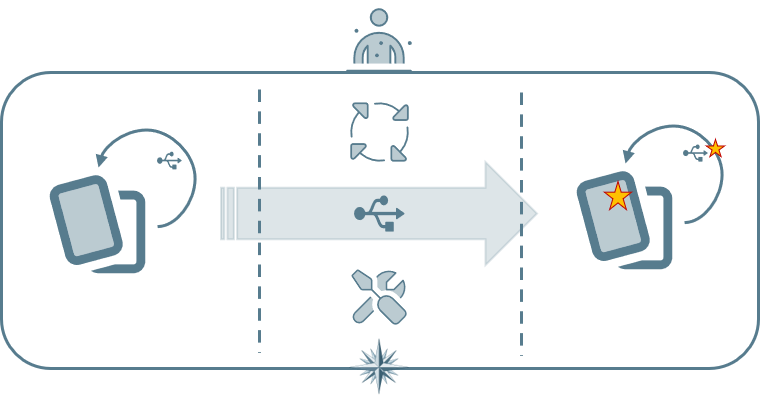
The Requirements Management Transformation Engine brings Requirements Engineering information under configuration control. It does not change the engineering content of an Information Element or relation; it creates and maintains the CI Record and verifies that the metadata required for controlled configuration management is present, valid and consistent.
Content remains content
A Requirement remains the Requirement created through Requirements Specification. A Stakeholder Need remains the Stakeholder Need created through Elicitation. An Analysis Statement remains the engineering information established through Analysis. Requirements Management does not reinterpret or rewrite these Information Elements.
The transformation
When an Information Element or relation is brought under configuration control, the Transformation Engine establishes its management record and checks that it complies with the applicable configuration rules. The same mechanism applies to Requirements and to other controlled RE Information Elements and relations.
Core checks
1 Completeness
Check whether all mandatory metadata fields for the Configuration Item are present and populated.
2 Validity
Check whether metadata values conform to the applicable rules, identifier schemes, permitted values and status conventions.
3 Consistency
Check whether the CI and its controlled relationships are consistent with the surrounding configuration, including references, versions and configuration states.
4 Resolve inconsistencies
Address missing, invalid or inconsistent management information before the Configuration Item is considered to have a valid configuration state.
The CI Record
The CI Record provides the management view of a Configuration Item. It does not replace the underlying Information Element or relation and does not duplicate its engineering content. Instead, it records the information required to identify, control and account for that CI throughout its lifecycle.
IMPULS3 principle. Engineering content and configuration-management information have different responsibilities. The CI Record controls the identity and configuration state of the Information Element or relation while the engineering content remains governed by the RE process that created it.
Requirements Engineering · Requirements Management
Information Model
 Information Model
Requirements Management does not introduce a separate engineering information model. It adds configuration control to selected Information Elements and relationships in the existing RE information model.
Core structure
Management metadata
The exact metadata depends on the type of CI and the applicable configuration rules. At minimum, the CI Record must make the Configuration Item uniquely identifiable and its current configuration state determinable. Typical metadata includes identifier, version, status, ownership, modification information and change references.
IMPULS3 principle. Configuration Management adds management information to the RE information model; it does not duplicate or replace the engineering content. Information Elements, relations and their CI Records retain distinct identities and responsibilities.
Requirements Engineering · Requirements Management
Tools & Techniques
 Tools & Techniques
Requirements Management uses tools and techniques to keep RE Information Elements and their relationships identifiable, traceable, searchable and internally consistent. The focus here is on capabilities that operate specifically on the RE information model.
RE-specific tools & techniques
1 Attribute & metadata management
Define, maintain and check the management metadata associated with RE Configuration Items. Mandatory fields, permitted values and metadata rules help ensure that CI Records are complete and valid.
2 Traceability management
Create, navigate and maintain typed relationships between RE Information Elements. Traceability checks can identify missing, invalid or broken relationships and preserve coherent reasoning chains as information evolves.
3 Querying & filtering
Search and select RE Configuration Items using their type, identifier, status, version, ownership, relationships or other metadata. Queries also help expose incomplete or exceptional configuration states.
4 Consistency & integrity checking
Apply automated or systematic checks to detect missing metadata, invalid values, duplicate identifiers, broken references and other inconsistencies within the controlled RE information configuration.
5 Impact analysis
Navigate from a proposed change through the relationships in the RE information model to identify Information Elements that may be affected and therefore require assessment before the change is accepted.
Tool support
These techniques can be supported by dedicated Requirements Management applications, model-based engineering environments, databases or other structured information-management tools. The essential capability is not the product itself, but its ability to manage RE Information Elements, their metadata and their relationships as structured information.
Relationship with Configuration & Change Management
 Relationship with Configuration & Change Management
Requirements Management uses Configuration & Change Management mechanisms within the Requirements Engineering domain. The generic mechanisms, governance and techniques for controlling configurations and changes are defined by the cross-cutting Configuration & Change Management process.
Requirements Engineering · Requirements Management
IMPULS3 Principles
Requirements Management preserves the trustworthiness of Requirements Engineering information as it evolves. IMPULS3 therefore applies a small set of principles that govern the identity, configuration state, change, traceability and integrity of controlled RE information.
1 Unique Identity
Every Configuration Item has a persistent and unique identity. Its identity remains stable while its content, metadata, status or version may evolve.
2 Explicit Configuration State
The configuration state of a CI must be determinable. Required metadata such as version and status is explicit, valid and maintained rather than inferred from documents or context.
3 Controlled Change
Changes to controlled RE information are explicit and traceable. The reason for change, its impact and the resulting decision are recorded before the controlled configuration is updated.
4 Immutable Baselines
A Baseline is an immutable snapshot of an identified configuration at a defined point in time. Changes never alter an established Baseline; they result in a new controlled configuration and, where appropriate, a new Baseline.
5 Traceability Preservation
Traceability is part of the controlled information configuration. Typed relationships between Information Elements are maintained as the configuration evolves so that provenance, reasoning and impact remain navigable.
6 Configuration Integrity
A controlled RE configuration is internally consistent. Required metadata is present and valid, identifiers are unique, relationships are valid, and inconsistencies are identified and addressed.
IMPULS3 principle. Configuration control does not imply that engineering content is correct, approved or final. It means that its identity, configuration state, metadata and relationships are known, controlled and demonstrably consistent.
 References