
 Requirements Engineering
Define, analyse, specify, validate and manage what the system must achieve.
Explore Requirements Engineering →
Quality Management
Plan, assure, control and improve the quality of engineering processes and their outcomes throughout the system lifecycle.
Explore Quality Management →
Requirements Engineering
Define, analyse, specify, validate and manage what the system must achieve.
Explore Requirements Engineering →
Quality Management
Plan, assure, control and improve the quality of engineering processes and their outcomes throughout the system lifecycle.
Explore Quality Management →
 The IMPULS3 framework
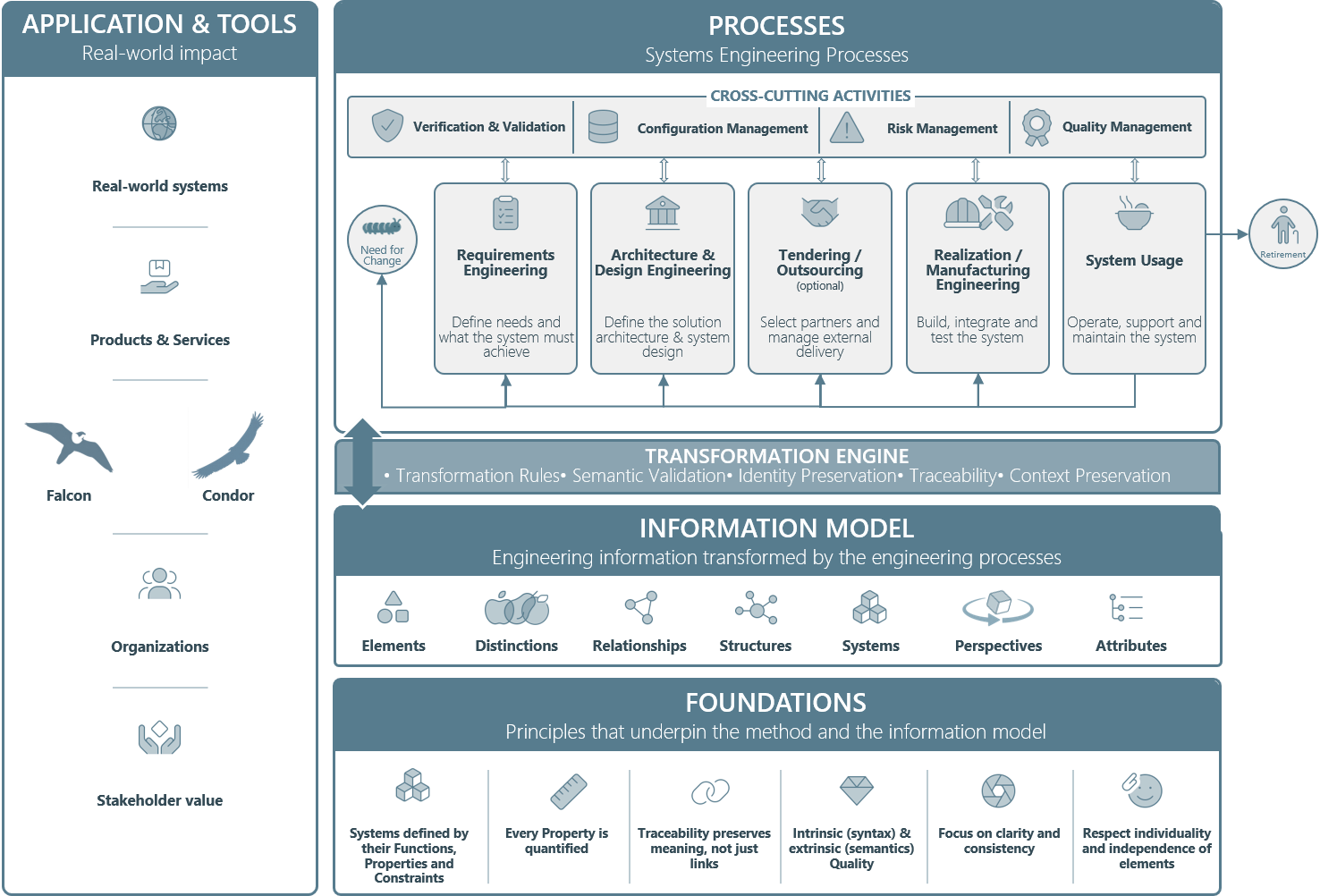
The IMPULS3 Framework provides a structured and consistent approach to Systems Engineering, with a strong emphasis on Requirements Engineering. It is designed to help organizations translate stakeholder needs into clear, complete, and verifiable system definitions, while maintaining control over complexity throughout the entire system lifecycle.
At its core, IMPULS3 is based on a simple but powerful principle:
Any system can be fully defined by its functions, properties, and constraints.
The framework brings this principle to life by combining foundations, an information model, processes, and real-world applications into one coherent structure.
How to read this framework
The framework is organized in four interconnected layers, each answering a fundamental question:
- Foundations – What principles guide our thinking?
- Information Model – How do we structure and represent information?
- Processes – How do we develop and evolve that information over time?
- Application & Tools – How is the method applied in practice?
Together, these layers ensure consistency from abstract principles to real-world systems.
Foundations – Principles that ensure clarity and consistency
The Foundations layer defines the principles that underpin the entire method. These principles ensure that systems are described in a way that is precise, unambiguous, and usable across disciplines.
Key principles include:
- Systems are defined by their functions, properties, and constraints
- Every property is quantified, enabling objective verification
- Traceability preserves meaning, not just links between artifacts
- Requirements quality is addressed both intrinsically (syntax) and extrinsically (semantics)
- A strong focus on clarity, consistency, and unambiguous concepts
- Respect for the independence of elements, with relationships explicitly modeled
These principles provide the foundation for everything that follows.
Information Model – A consistent structure for systems and requirements
The Information Model defines how systems, requirements, and their relationships are structured and represented.
Instead of relying on implicit assumptions or tool-specific constructs, IMPULS3 uses a consistent and explicit model consisting of:
- Elements (defined by functions, properties, and constraints)
- Distinctions (what something is—and what it is not)
- Relationships (explicit, conditional, and context-dependent)
- Structures (how elements are organized)
- Systems (coherent sets of related elements)
- Perspectives (different stakeholder views)
- Attributes (quantified properties and supporting data)
This model is not static. It evolves over time as the system is better understood and further developed.
Processes – Evolving the information model
The Processes layer describes how the information model is created, refined, and validated throughout the system lifecycle.
At the highest level, IMPULS3 distinguishes five core Systems Engineering processes:
- Requirements Engineering – defining stakeholder needs and system requirements
- Architecture & Design Engineering – developing the system structure and solution
- Tendering / Outsourcing (optional) – selecting and managing external partners
- Realization / Manufacturing Engineering – building, integrating, and testing the system
- System Usage – operating, supporting, and maintaining the system
The lifecycle is initiated by a Need for Change and ends with Retirement, while feedback from system usage continuously drives improvement.
Cross-cutting activities
Across all processes, a set of cross-cutting activities ensures quality and control:
- Verification & Validation
- Configuration Management
- Risk Management
- Quality Assurance
These activities are not separate phases, but are continuously applied throughout the lifecycle.
Application & Tools – Bringing the method into practice
The Application & Tools layer connects the framework to real-world use.
IMPULS3 is applied in the development and management of:
- Real-world systems
- Products and services
- Organizational capabilities
- Complex, multidisciplinary environments
Supporting tools enable the practical implementation of the method, allowing users to:
- Structure and manage system information
- Maintain traceability
- Analyze relationships and dependencies
- Support decision-making
A consistent whole
The strength of IMPULS3 lies in the tight integration of its layers:
- The Foundations define the rules
- The Information Model provides the structure
- The Processes evolve the model
- The Applications demonstrate its value
Processes do not create separate models, they continuously transform a single, consistent information model.
This ensures that meaning is preserved, complexity is controlled, and decisions are based on reliable and traceable information.
 References